
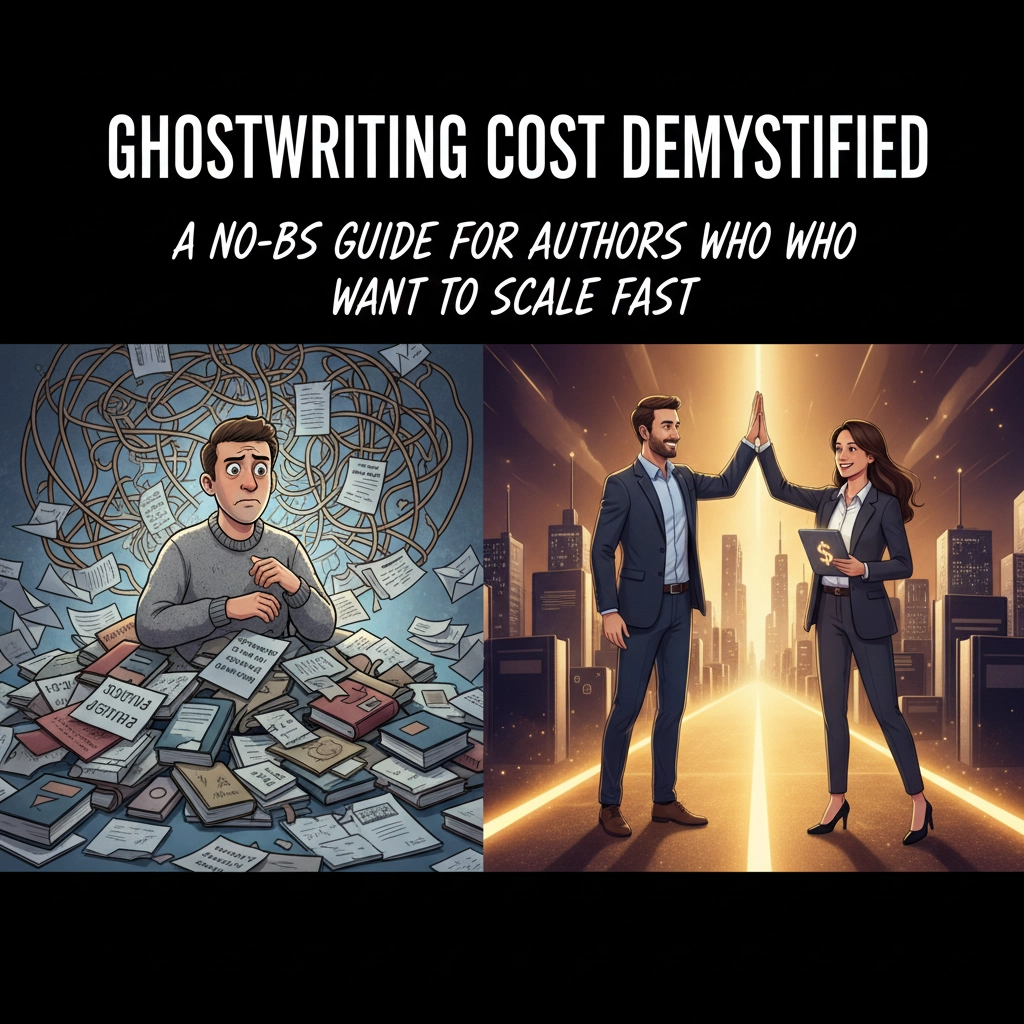
The Real Problem with Ghostwriting Costs (It’s Not What You Think)
Let’s cut through the BS right up front. Ghostwriting pricing is a complete minefield. One writer quotes you $3,000 for a novel. Another asks for $30,000. A third wants $300 per hour with no guarantee of completion.
What’s going on here? Are they all delusional, or are you missing something fundamental?
Here’s the uncomfortable truth — most authors approach ghostwriting costs backwards. They fixate on per-word rates like they’re buying bulk rice, when what they’re really purchasing is risk management, process expertise, and output quality.
Think about it this way — when one author lost $16,000 on a ghostwriter, it wasn’t because the writer charged too much. It was because the author didn’t understand what they were actually buying.
The emotional context here matters. We’ve talked to hundreds of indie authors who got burned by bad ghostwriting experiences. They paid “bargain” rates and received manuscripts that needed complete rewrites. They hired based on price alone and ended up with writers who disappeared mid-project. They signed contracts that left them with no recourse when deliverables fell short.
Cost isn’t about word count. It’s about risk management, process, and output quality.
What This Guide Actually Covers (Spoiler: Everything)
This isn’t another surface-level “ghostwriting costs between X and Y” article. You’ll find those everywhere, and they’re useless for making real decisions.
Instead, you’re getting a complete breakdown of:
- Pricing models that actually work (and the ones that’ll burn you)
- How genre differences impact your budget by thousands
- Contract terms that protect your investment
- ROI math that proves when paying more saves money
- Red flags that scream “run away now”
By the end, you’ll budget intelligently, avoid scams, and most importantly, understand exactly what your money should buy, chunk by chunk.
What You’re Actually Paying For (Hint: It’s Not Just Words)

When you hire a ghostwriter, here’s what your money actually covers:
Time. Research, actual writing, and revisions. But this isn’t just “typing fast.” It includes outlining, story architecture, character development, and quality control. Cheap writers cut corners here first.
Expertise. Genre mastery and market familiarity. A romance ghostwriter knows reader expectations for pacing, heat levels, and emotional beats. A mystery writer understands clue placement and red herrings. This knowledge prevents costly rewrites later.
Process. Editing, quality control, and systematic delivery. Professional ghostwriters have refined workflows that catch problems early, maintain consistency, and deliver clean manuscripts. Amateur writers wing it.
Communication. Feedback loops, progress updates, and collaborative refinement. Good ghostwriters involve you in the process without overwhelming you. Bad ones disappear for weeks then dump 50,000 words of trash.
Opportunity Cost. Their focused attention on your project instead of someone else’s. Experienced writers have waiting lists. When they commit to your book, they’re turning down other work.
Here’s the kicker. Cheap work equals corners cut in these areas. Always. A $5,000 novel gets minimal research, no real editing process, poor communication, and a writer who’s juggling six other projects simultaneously.
Common Pricing Models Explained (And Which Ones Work)

Per-Word Pricing is most common in fiction, typically ranging from $0.02 to $0.15+ per word. Sounds simple, but it creates perverse incentives. Writers get paid more for longer books, regardless of quality. Expect ranges like:
- Entry-level: $0.02-$0.05 per word
- Experienced: $0.05-$0.10 per word
- Premium: $0.10-$0.15+ per word
A 70,000-word novel costs $1,400-$10,500 depending on the writer tier.
Flat Project Fees offer stability for both parties. You know exactly what you’ll pay upfront. The writer can’t pad word count for bigger paychecks. But it requires clear scope definition. Changes cost extra.
Hourly Rates are rare for fiction and risky for clients. Rates vary from $50-$250+ per hour, but you have no cost predictability. Slow writers cost more than fast ones, regardless of output quality.
Royalty Share/Hybrid Deals sound attractive but are usually false economy. “Pay me $5,000 upfront plus 25% of royalties forever” means you’re paying twice. Once for the work, then again every time the book earns money. Avoid these unless the upfront fee is genuinely discounted.
Realistic Price Ranges (Based on Actual Market Data)
Let’s talk real numbers from established platforms like Reedsy and professional agencies:

Entry-Level Freelancers ($3,000-$8,000)
- New to ghostwriting or building portfolios
- Basic project management and communication
- 1-2 revision rounds included
- Limited genre expertise
- Higher risk of project issues
Experienced Genre Specialists ($8,000-$25,000)
- Proven track record in your specific genre
- Professional project management systems
- Multiple revision rounds and collaborative editing
- Understanding of market expectations
- Moderate risk with good communication
Professional Agencies ($15,000-$50,000+)
- Team-based approach with editors and project managers
- Comprehensive quality control processes
- Extensive revision and refinement cycles
- Market positioning and publishing guidance
- Lowest risk with systematic delivery
The sweet spot for most scaling indie authors? That middle tier. You get professional expertise without premium agency overhead.
How Genre Impact Actually Works (And Why It Matters)
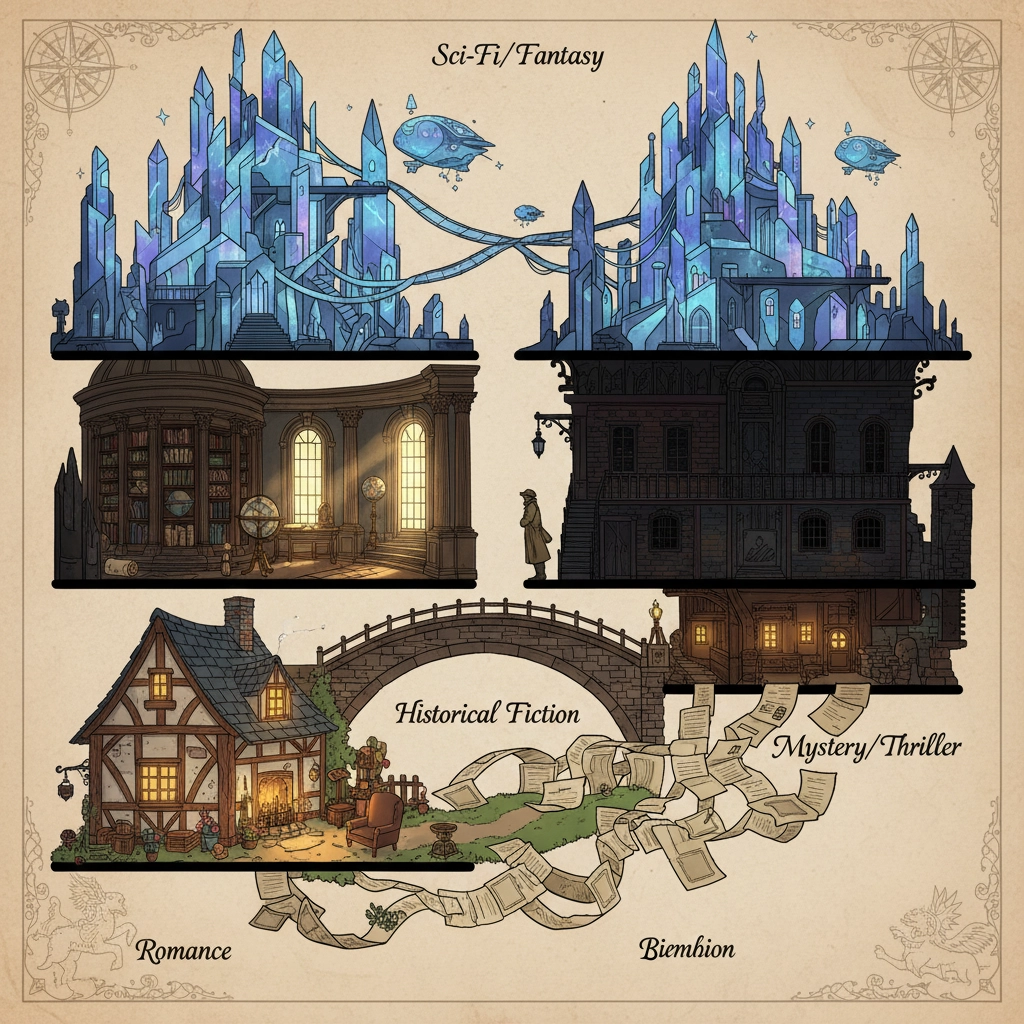
Romance moves fast with shorter research requirements, leading to lower per-word costs. Readers want emotional satisfaction and familiar tropes executed well. A skilled romance ghostwriter can deliver quality at $0.05-$0.08 per word because they know the formula.
Science Fiction/Fantasy demands extensive worldbuilding and consistency tracking. Creating believable alien cultures or magic systems takes serious time. Expect to pay $0.08-$0.12+ per word for quality spec-fic because the research and planning overhead is substantial.
Mystery/Thriller requires complex plotting with careful clue placement and pacing. Plot holes kill these books, so experienced mystery writers charge premium rates ($0.10-$0.15+ per word) for the intricate planning required.
Historical Fiction is research-heavy with accuracy requirements that slow production. Good historical ghostwriters spend weeks verifying period details, language, and social contexts. Budget 25-50% more than contemporary fiction.
The difference between “pulp speed” and “literary depth” also shifts pricing dramatically. Formulaic genre fiction can move quickly. Literary fiction or complex narratives require more development time and cost accordingly.
Our 20,000-word chunk system at Ghostwriting Wranglers aligns perfectly with these efficiencies. Instead of committing to full novels upfront, you can test fit and build momentum through manageable segments.
The Research Variable (Where Costs Explode)
Research requirements can multiply your ghostwriting costs dramatically. Simple contemporary romance with minimal research might need 10-15 hours of prep work. Historical mystery set in Victorian London? That’s 40-60 hours before writing even begins.
Time sinks that raise costs include:
- Historical research and fact-checking
- Technical/professional expertise (medical, legal, military)
- Style mimicry for branded content
- Story bible creation for complex series
- Interview coordination and transcription
When paying more makes sense: Complex universes, long series continuity, or specialized knowledge domains. If your book requires genuine expertise, cheap ghostwriters will fake it, and readers will notice.
Standard Payment Structures (That Actually Protect You)
Industry standard: 30-50% deposit, milestone payments, final payment before rights transfer. This exists for mutual protection.
The deposit covers initial outlining and planning work. Milestone payments (usually 25-30% each) are tied to specific deliverables: first draft, revised draft, final manuscript. Final payment releases upon delivery of the complete, approved manuscript.
This structure ensures:
- Writers get paid for completed work
- Authors see progress before paying more
- Both parties stay committed to the project
- Quality issues get caught early
Any deviation from this model should raise immediate red flags.
Common Red Flags (That’ll Cost You Thousands)
“Payment on acceptance/publication”. Translation: “Maybe you’ll get paid, maybe you won’t.” Professional writers don’t work for free while you shop your manuscript around.
No IP transfer clause. If the contract doesn’t explicitly transfer all rights to you upon final payment, you might not own your own book. We’ve seen authors discover they can’t publish without ongoing royalty payments to their ghostwriter.
No revision or termination language. What happens if you hate the first draft? If the writer disappears? If you need to end the project early? Contracts without clear termination and revision policies leave you powerless.
Full balance before work starts. Legitimate professionals don’t demand 100% upfront payment. This screams scam or cash flow problems.
“Too good to be true” pricing with no milestones.”$2,000 for a full novel, payment upfront” usually means you’ll get 20,000 words of AI-generated nonsense, if anything at all.
Safer, Smarter Alternatives (The GWW Model)
At Ghostwriting Wranglers, we pioneered a Pay-As-You-Go model that eliminates most ghostwriting risks:
- $600 deposit starts your project
- 5,000-20,000 word chunks delivered incrementally
- Transparent billing for each segment
- Review and approval cycles between chunks
- You can pause or redirect at any milestone
This approach mitigates both author and writer risk. Authors see exactly what they’re getting before committing to more. Writers get paid for completed work segments. Nobody gets trapped in bad projects.
You can read more about how our payment terms work and why transparency builds trust.
The False Economy of Cheap Ghosts

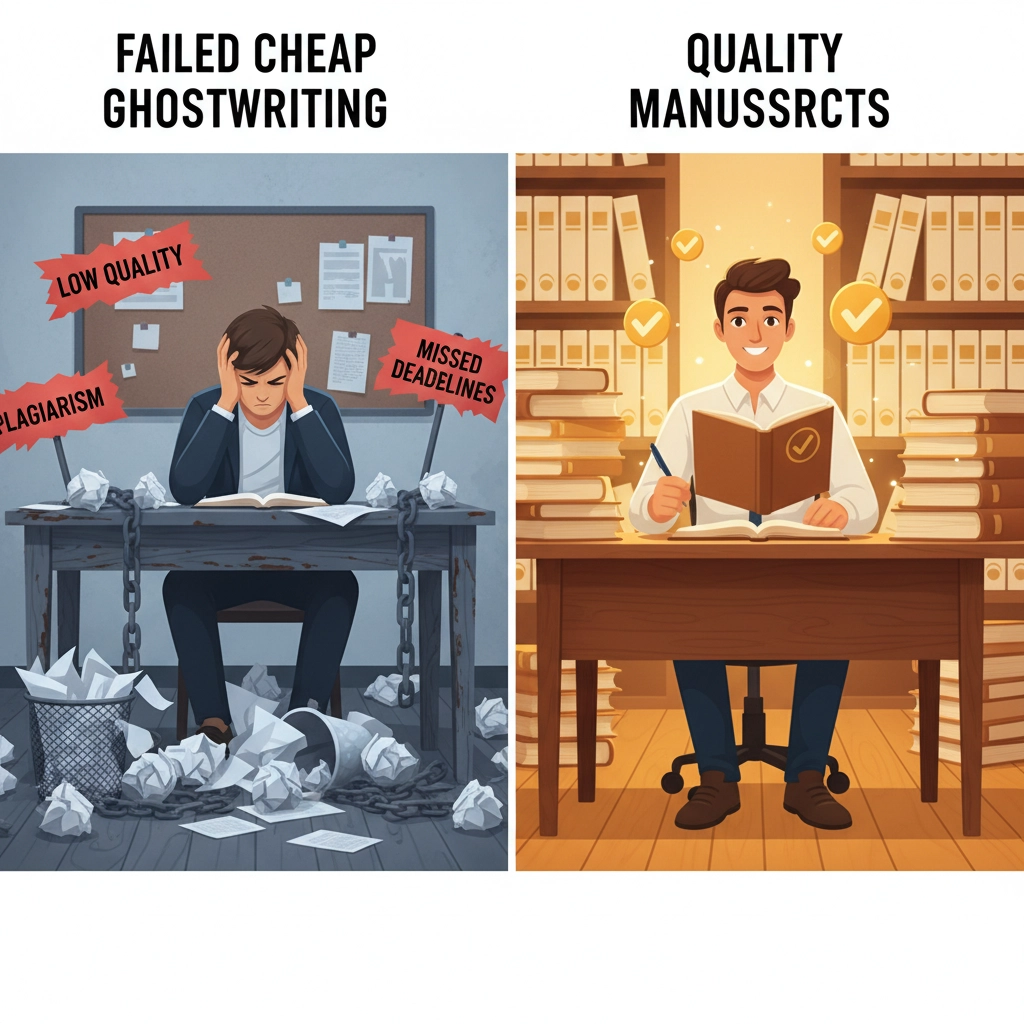
Here’s a real story — Author hires cheap ghostwriter for $1,000. Receives 50,000 words of generic, poorly-structured content. Spends $3,000 on developmental editing and rewrites. Total cost: $4,000 for what should have been a $2,500 project with a competent writer.
Cheap work costs more through rewrites and delays. When you hire based on price alone, you typically get:
- Generic content lacking your voice or brand
- Poor story structure requiring extensive revision
- Inconsistent characters and plot holes
- Missed deadlines that delay your publication schedule
- Communication problems that slow the entire process
The math is brutal but consistent. Bargain ghostwriting + professional fixes = premium ghostwriting costs, except you waste months in the process.
How to Calculate ROI on a Ghostwritten Book
Let’s run real numbers on ghostwriting ROI:
Simple Model:
- Ghostwriting cost: $15,000
- Average monthly royalties on KDP: $800
- Break-even point: 19 months
- Year 2+ profit: $9,600 annually
Compounding Benefits:
- Book 1 profits fund Book 2 ghostwriting
- Series builds audience and increases per-book earnings
- Clean publishing pipeline enables rapid release schedule
- Professional quality improves reviews and discoverability
The Speed Factor: A quality ghostwritten book reaches market 6-12 months faster than if you wrote it yourself. That head start often pays for the ghostwriting cost through extended sales runway.
Stop obsessing over penny-per-word calculations. Focus on speed-to-market and revenue predictability.
The Intangible ROI (Peace of Mind Has Value)
Beyond pure math, ghostwriting delivers stress savings that impact your entire business:
Time Freedom. Instead of spending 6-12 months writing, you focus on marketing, audience building, and business development.
Emotional Energy. No more staring at blank pages, wrestling with writer’s block, or second-guessing every chapter.
Consistency. Professional ghostwriters deliver on schedule. Your publishing calendar becomes predictable instead of aspirational.
Quality Assurance. Experienced genre specialists understand market expectations and reader psychology better than most authors.
As we tell our clients: “You’re not buying a book. You’re buying peace of mind.”
Structure creates speed. Predictability enables scaling. Quality generates sustainable income.
When Paying More Makes Sense
Scaling a Series. If you’re planning 5+ books in the same universe, investing in a premium ghostwriter pays dividends across every volume.
Transitioning to New Genre. Moving from contemporary fiction to historical fantasy? Pay for genuine genre expertise instead of learning through expensive mistakes.
IP for Adaptation. Planning to pitch your book for screen rights? Professional-quality manuscripts get serious consideration from agents and producers.
Long-term Brand Building. If this book establishes your authority in a market, invest in quality that reflects your professional positioning.
Remember, quality equals predictability, and predictability enables scalability.
The System That Keeps Costs Predictable
Our 5-Step GWW Process eliminates the chaos that destroys ghostwriting budgets:
1. Recruit Smart. We hire writers with proven genre experience and professional track records.
2. Train Efficiently. Every writer learns our quality standards and communication protocols before touching client work.
3. Deliver in Chunks. The 20,000-word rule keeps projects manageable and gives you control points throughout the process.
4. Built-In Quality Control. Multiple review cycles catch issues early, preventing expensive revisions later.
5. Post-Production Polish. Final editing ensures manuscript quality matches your investment level.
Each step connects to cost control and ROI optimization. You’re not paying for improvisation. You’re investing in proven systems.
Our Pricing Philosophy
Fair pricing means sustainable pricing. We structure rates that let writers focus on quality instead of juggling multiple projects for survival income.
Transparent pricing means predictable budgets. You know exactly what each project phase costs before committing.
Collaborative pricing means shared success. When your books succeed, we all win. When projects struggle, we work together to find solutions.
This approach works for indie authors who care about both profit and creative control.
Questions to Ask Before Hiring Any Ghostwriter
Genre Experience. “How many books have you written in [your specific genre]? Can I see samples?”
Sample Chapter. “Will you write a 1,000-word sample chapter before we commit to the full project?”
Milestone Structure. “How is the project broken down? When do I see drafts for review?”
Rights Ownership. “What exactly transfers to me upon final payment? Any ongoing royalty claims?”
Revision Policy. “How many revision rounds are included? What happens if major changes are needed?”
Communication Standards. “How often will you update me on progress? What’s your typical response time?”
Get specific answers. Vague responses indicate amateur operations.
How to Compare Quotes Intelligently
Don’t just compare bottom-line prices. Examine what’s actually included:
Missing Deliverables. Does the quote include outlining? Editing passes? Final formatting? Hidden costs add up quickly.
Communication Policies. Weekly updates vs. radio silence until completion changes your stress levels dramatically.
Process Transparency. Can you review work at multiple stages, or do you see nothing until the final manuscript?
Revision Allowances. Some writers include extensive revision cycles. Others charge extra for any changes beyond basic proofreading.
The cheapest quote often excludes services you’ll need to purchase separately.
Budget Planning for Serious Authors

Forecast ghostwriting as part of your publishing pipeline. If you’re planning 2-3 books per year, budget accordingly.
Recommended Budget Ratios:
- Writing/Ghostwriting: 40-50%
- Editing and Proofreading: 15-20%
- Cover Design and Formatting: 10-15%
- Marketing and Promotion: 20-25%
- Miscellaneous (ISBN, distribution): 5-10%
Profit Reinvestment Strategy. Use Book 1 earnings to fund Book 2 production. By Book 3, you should be profitable enough to invest in premium ghostwriting tiers.
Track your numbers. Successful indie authors treat writing as business investment, not creative expense.
The Big Reframe (Stop Buying Words, Start Buying Results)
Here’s what this all comes down to.
You’re not buying words. You’re buying speed, sanity, and scalability.
A great ghostwriting relationship transforms from expense into strategic partnership. Instead of struggling through writer’s block and self-doubt, you focus on marketing, audience building, and business development while professional writers handle manuscript production.
Instead of hoping your next book gets finished someday, you plan realistic publishing schedules that build audience momentum and generate predictable income.
Instead of sweating over every scene and character decision, you collaborate with genre experts who understand market expectations and reader psychology.
A great ghostwriting relationship is an investment, not an expense.
Ready to Get Started? (We’ll Show You Exactly What Your Money Buys)
We believe in radical transparency because it builds trust and sets realistic expectations.
When you work with Ghostwriting Wranglers, you’ll see exactly what your investment covers, chunk by chunk. No surprises, no hidden fees, no mysterious processes.
We’ll show you our systematic approach to quality control, our milestone-based delivery system, and our commitment to collaborative success.
Want to understand how our transparent pricing works for your specific project? We’ll walk you through the numbers without pressure or pushy sales tactics.
Because the goal isn’t just to write your book — it’s to build a sustainable publishing system that scales with your ambitions.
Get your transparent quote here and discover what professional ghostwriting actually delivers when done right.
Every great author business starts with one decision: invest in systems that work, or keep struggling with approaches that don’t.
Which path makes sense for you?
